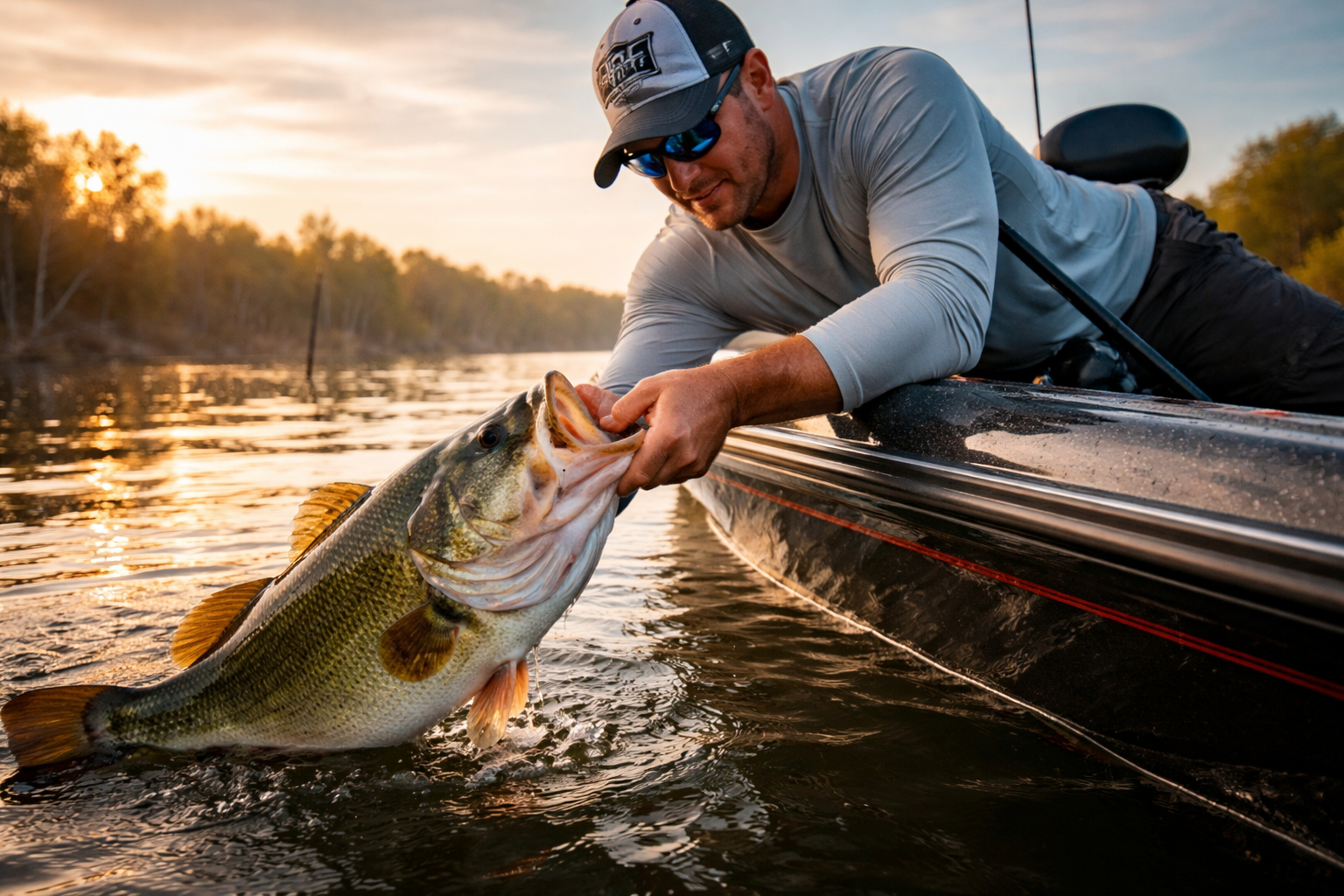
Keith Warren brings you the finest in bass fishing, saltwater fishing and hunting television programing into your home each week with his Texas Angler and Hunting and Outdoor Adventures television programs.


OUTDOORS WITH THE TEXAS ANGLER


Kieth Warren

The boat ride was long, especially so early in the morning. We had traveled about 45 minutes from Marker 37 located under the JFK Causeway near Flour Bluff, Texas.

The sun was barely making its way up and was visible only briefly due to the clouds on the eastern horizon. It was 7:00 a.m.

I was joined by Captain Cliff Webb of Corpus Christi and Barry Day from Iowa. We would be field testing a new bass lure to see how well it worked on speckled trout and redfish.

Capt. Webb has guided for more than 17 years in the Laguna Madre and has come within an inch of catching the new Texas State Record speckled trout several times. The current state record trout was 13.11 lbs. and caught by one of Webb's clients, Jim Wallace of Houston, who had fished with him only days earlier.

The spot where we stopped looked promising. We were only 100 yards from the intercoastal canal, fishing the back side of numerous islands. I was surprised to see the water so clean because it had been windy along the coast.

The lure is a lipless crankbait called the Frenzy Rattler. Each of us had one of three different colors tied on. The Frenzy will sink at rest so a steady retrieve is necessary to avoid hanging on grass or the bottom.

Webb was throwing the Firetiger, Day the gold and black, and I was using chrome and blue. Keep in mind these are bass lures with bass colors.

By the third cast, both of my partners had fish hit the noisy hard plastic lure. Lots of strikes but the hook-up ratio was looking poor. I still hadn't had a strike. Then Captain Webb figured it out.

He began to yo-yo the bait back, much like fishing a soft plastic in saltwater. Almost every cast ended with a fish on the Frenzy! Barry and I duplicated the retrieve. Instantly Barry hooked up but I never had a strike. I kept thinking, "It must be the color."

I decided to change to gold and black and the first cast hooked up. A nice trout, 22 inches. It hadn't been half an hour when we'd boated over 20 trout! The Frenzy was working!

On my next cast I had a big one strike and start taking drag. "Must be a redfish." Said our guide. It was. After a brief two minute battle, the 26" red was brought aboard.

"How's that for a bass lure?" I said. Changing colors was obviously a good idea. We only fished two hours, boated and released a mixed catch of sixty trout and reds, all on the Frenzy.

On the long ride back I thought about how many lures are made and how some fishermen may classify freshwater lures and others saltwater lures. I've seen too many times when the same lure worked equally well in both waters.

Trout and redfish are very similar to black bass. They are all predators and feed on smaller fish. Select lures that closely resemble the natural forage in looks and action and you'll catch fish.

Lots of saltwater anglers are learning to overlook the freshwater classification of lures and are catching more trout and redfish on bass lures.


As the afternoon sun sank below the horizon, my hopes were high. It had been your typical early summer afternoon. The water temperature was in the mid-80's and the air temperature was near 90 degrees. Although it seemed hot, I knew that the real heat of the Texas summer was still yet to come.

I completed the task of anchoring my boat fore and aft to prevent any movement. The videographers had been working at a brisk pace to get their equipment and lights set up before darkness settled in.

This would be my first time to use the Fisherman's Greenlight this summer. I'd discovered the product four years ago and had become increasingly confident with each use.

The 12 volt submergible light puts off a bright green glow in the water. A standard 12 volt battery will operate the light for over two entire nights. It's purpose is to attract small bait fish, and in turn attract game fish which feed on the bait fish.

I'd used lots of other lights on the market before and had some success, but it was spotty at best. The results with this light had been noticeably different. It seems to work better attracting fish than other lights.

I lowered two five foot Greenlights below the surface and tied them off to the side rails of my boat. Each light was hanging horizontally just below the boat. I prefer to do it this way as the boat acts like a giant reflector, forcing light to the bottom.

The darker the sky became, the brighter the green in the water became. Finally I could no longer make out any trees along the shoreline. The temperature had dropped to become very comfortable and the noises in the darkness kept me entertained.

My first cast below the boat resulted in a solid thump. I boated a 14 inch crappie. "They're here boys!" I told the cameramen. Although a live minnow is the best bait to catch crappie, I was using a Road Runner jig. It's the next best thing.

After boating a dozen slab-sized crappie, I set the hook on something bigger! It turned out to be a three pound bass. Then there was a four pound largemouth on the next cast!

I'd been fishing for two hours now. The action was good but certainly not exceptional. But the amazing part was that the crappie were all 14 inches or longer! Each one weighed two pounds or more!

Another two hours later and I had finished out my limit of 25 crappie. Mixed in the catch were some largemouth that had been released and several bream pushing the one pound mark. Then something happened!

The action just stopped. No bites at all. Occasionally my Humminbird would bleep, indicating a fish under the boat, but no bites.

The silence of the darkness was broken only by howling coyotes in the moonlight. Suddenly there was a soft mushy feel on the end of my rod. I set the hook and held on.

Without a doubt it was a fish. A big fish! We had more than enough good video for a show, but I really wanted to at least see this monster. It would be all right if it got off, but I just wanted to see it!

After three minutes of drag screaming, the fish surfaced and splashed water all over me. "A big blue cat!" I yelled. With two cameras rolling, I managed to slide this old giant into my net. It turned out to be a 25 pounder, estimated to be 15 years old! It's the largest freshwater fish I've ever caught under the Greenlight.

After releasing the giant, we pulled up anchor and headed in. "Not bad for this early in the summer." My producer said. "Just wait until the Greenlight action gets good!"

I smiled and thought to myself, this was a great trip, but he's right, the hotter the days become, the better the action is at night under the Fisherman's Greenlight.

For more information on the Fisherman's Greenlight, call 800-388-1000.


Deep, clear reservoirs are scattered throughout the country and many of them hold bountiful numbers of crappie. After these fish spawn though, they migrate into deep water and will often suspend through Summer months. During this time, daytime fishing becomes slow and the night time crappie action gets serious.

By fishing the downwind side of a lake, anglers can find concentrations of crappie. Wind currents push shad into these areas. The ideal spot to fish here is where a channel turns out and there are some large trees holding near a bank.

After you find a spot, try putting out a Fisherman's Greenlight. This is a submergible light powered by a 12 volt marine battery. It attracts baitfish which in turn attract crappie and bass. For more information on Fisherman's Greenlight call 1-800-388-1000.

Fishing a tight line rig with a minnow and 4 pound test line, lower a live shiner down to the level of the shad on your depth finder and then slowly reel up until you find the fish. If you can mark the spot where you find the fish by marking where your line is with a magic marker before reeling the first fish in, you should have no problem catching these clear water crappie.

If the action gets heavy, you might want to switch to a Blakemore Road Runner jig so that you don't have to fool with baiting your hook every time you catch a fish. Most professional crappie guides will use the shiners to find the fish then switch to jigs to put them in the boat.

The wise angler will work a couple of areas in the course of a night to tap into different schools of fish. Crappie will engage in little feeding frenzies and can turn off at the drop of a hat, or should I say minnow.


Ask any serious speckled trout angler what's the all around best bait for trophy trout and they'll answer "live croaker". This small bait fish is a natural enemy of the speckled trout. It preys on speckled trout eggs.

Croaker looks similar to a small redfish (without the spot). They are available at bait stands along the coast on a daily basis. Shrimpers bring the croakers in each day and sell them as part of their bycatch. The problem is finding them.

Because they are so effective at catching big trout, most guides establish a relationship with bait stand owners. I know of many anglers who have to get to bait stands at 2:00 a.m. to get their croaker. The guides usually show up at 4:00 a.m. Certainly arrangements need to be made with a bait stand well in advance to get your bait.

I fish with croaker a half dozen times each year. Most recently my guide, Captain Bill Sheka, Jr. took me to Baffin Bay where we landed over 100 trout up to 28 1/2 inches long in only five hours!

Sheka's technique is to fish Baffin's rock piles (which are now visible) with bright sun and a good set of sunglasses. Simply hook the croaker above the anal fin in the line on the side of the fish, using a specialty Mustad croaker hook. The hook is tied directly to 14 lb. test Fireline. This is a new, no stretch super line that's perfect for croaker fishing. Use no weight. It will cause the croaker to get hung on the rocks.

The more alive they are, the better. You want them working on the end of your line. Make long casts to the rocks. Allow the croaker to swim freely, then slightly pump the rod, forcing the croaker to have to swim. This will also force the bait to emit a croaking noise that will attract trout. Don't give the croaker too much slack because it will swim into the rocks and get hung up.

Rod position is a key. Keep the rod tip from the 10:00 - 12:00 position with the reel engaged. When a trout takes the bait, drop the rod top and simply set the hook. There is no need to allow the fish to swallow the croaker, as with monofilament line. Remember, Fireline has no stretch!

Many saltwater anglers believe using croaker for trout kills too many fish. It does kill some if they are allowed to swallow the bait. So use Fireline and make quick locksets. You'll hook them in the side of the mouth 90% of the time.

Things to remember:

1) Make arrangements early with bait stands for bait.

2) Avoid throwing dead croaker in water. They'll attract seagulls, which will take your good croaker before it gets under the surface.

3) Keep croaker lively in a good aerated bait well.

4) Prior to casting, hold croaker tightly in hand and shake vigorously. It'll make it croak more.

5) When croaker become weak, try hooking two on the same hook.

If you've never caught a trophy trout, you need to try live croaker. It'll make a believer out of you!

Catch the Texas Angler locally on or check your local listings

for show times. You can also watch Keith Warren on Fox Sports Southwest on Sunday mornings at 8:30 a.m. You can reach the Texas Angler at P. O. 3I0601, New Braunfels, Texas 78131-0601, or visit us online at www.txang-hoa.com .


Texas Coastal Tides


Send mail to ibwebinfo@ibweb.com with questions or comments about this web site.
Copyright ©
2000 Texas SportsGuide
Last modified: January 10, 2000

ImageBulders Web DesignCopyright © 2000 Texas SportsGuide Home